


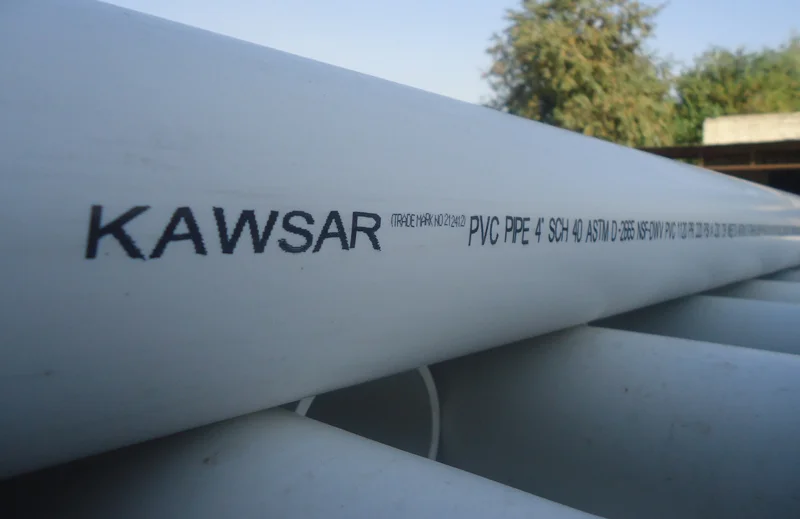
Kawsar uPVC Pipes
Kawsar uses the best quality PVC resin and compounds to ensure that desirable physical properties are maintained with every production run. Kawsar PVC piping exhibits exceptional consistency in quality with uniform properties, making it the preferred choice for fabricators and custom houses.
Kawsar’s product line has grown to include standard and custom extrusions of PVC pipe in schedules 40, 80, and 120, as well as SDR series pipes produced in dimensions of 13.5, 21, 26, and 41. Kawsar uPVC pipes are offered in sizes ranging from ½” to 12” and are suitable for pressure applications of up to 15 bars.
Kawsar uPVC has a life cycle of over 100 years, provided that correct formulation and careful processing are followed. In addition to a full range of sizes, Kawsar also offers various options, including belled ends, gasket ends/Z-joints, and threaded pipe ends, as well as custom dimensions and lengths. Kawsar PVC pipe is ideal for numerous applications, including chemical processing, water supply, sewerage, vent and drain systems, high-purity applications, water and wastewater treatment, potable water systems, agriculture, irrigation, plating, and many other industrial applications involving corrosive fluid transfer.
About our product
General Properties Of uPVC Pipes
- Can be joined with solvent cement.
- Fully compliant with major international standards.
- Available in different lengths: 3m, 4m, and 6m, with other lengths available upon request.
- Superior chemical and acid resistance.
- Outstanding mechanical properties, including high tensile strength.
General Features Of uPVC Pipes
- High-quality finish with smooth internal and external surfaces.
- Low coefficient of flow friction.
- Excellent resistance to chemicals commonly found in domestic effluent.
- Remains stable under elevated temperatures.
- Formulated to withstand weathering effects.
International Standards
- ASTM D1785, Sch – 40
- ASTM D2665
- Sch-80
- BS-3505
- PSI 3051
- DIN 8061
- DIN 8062
Advantages of Kawsar uPVC Pipes

Easy Installation

Low Thermal Conductivity

Strong and Durable

Long Operating Life

Free from Toxicity

Leak Proof

Fire Resistance

Resistance to Moisture

Cost Effective

Low Friction Loss
Applications of uPVC Pipes
The intrinsic properties of PVC make it suitable for a wide variety of applications. Its biological and chemical resistance makes it the plastic of choice for most household sewerage systems and other piping applications where corrosion would limit the use of metal. This standard applies to uPVC pipes, fittings, and their joints, as well as to joints with components made of other plastics (marked with “13” or “BD”).
Used for the following purposes:
- Soil and waste discharge pipework
- Rainwater pipework
- Ventilation pipework
- Water supply
- Pressure piping
- Sewerage, vent, and drain systems
- Potable water supply
- Chemical installations
- Food industry applications
- Industrial piping
- Water treatment
- Irrigation water supply
Additional Information
Mechanical & Physical Characteristics
| Characteristics | Requirement | Test Method |
|---|---|---|
| Impact Resistance | TIR ≤ 10% | EN 744 |
| Vicat Softening | ≥ 79o C | EN 727 |
| Longitudinal Reversion | ≤ 5% | EN 743 |
| Resistant to Dichloromethane | No attack | EN 580 |
| Elevated Temp. Cycling | No leakage | EN 1055 |
uPVC Pipes Dimensions in Millimetres
| Outer Diameter (MM) |
Mean Outside Diameter | Wall Thickness Application Area “B” | ||
|---|---|---|---|---|
| (DEM, MIN) | (DEM, MAX) | (E.MIN) | (E.MAX) | |
| 56 | 55.8 | 56.1 | 3.0 | 3.5 |
| 63 | 63 | 63.2 | 3.0 | 3.5 |
| 82 | 82 | 82.3 | 3.0 | 3.5 |
| 90 | 90 | 90.3 | 3.0 | 3.5 |
| 110 | 110 | 110.3 | 3.0 | 3.5 |
| 160 | 160 | 160.4 | 3.0 | 3.5 |